Understand Sales and the Buyer
Explore the meaning of sales, the new buyer, brain research related to buying behavior, and factors that can influence purchasing decisions.
 Coming Soon
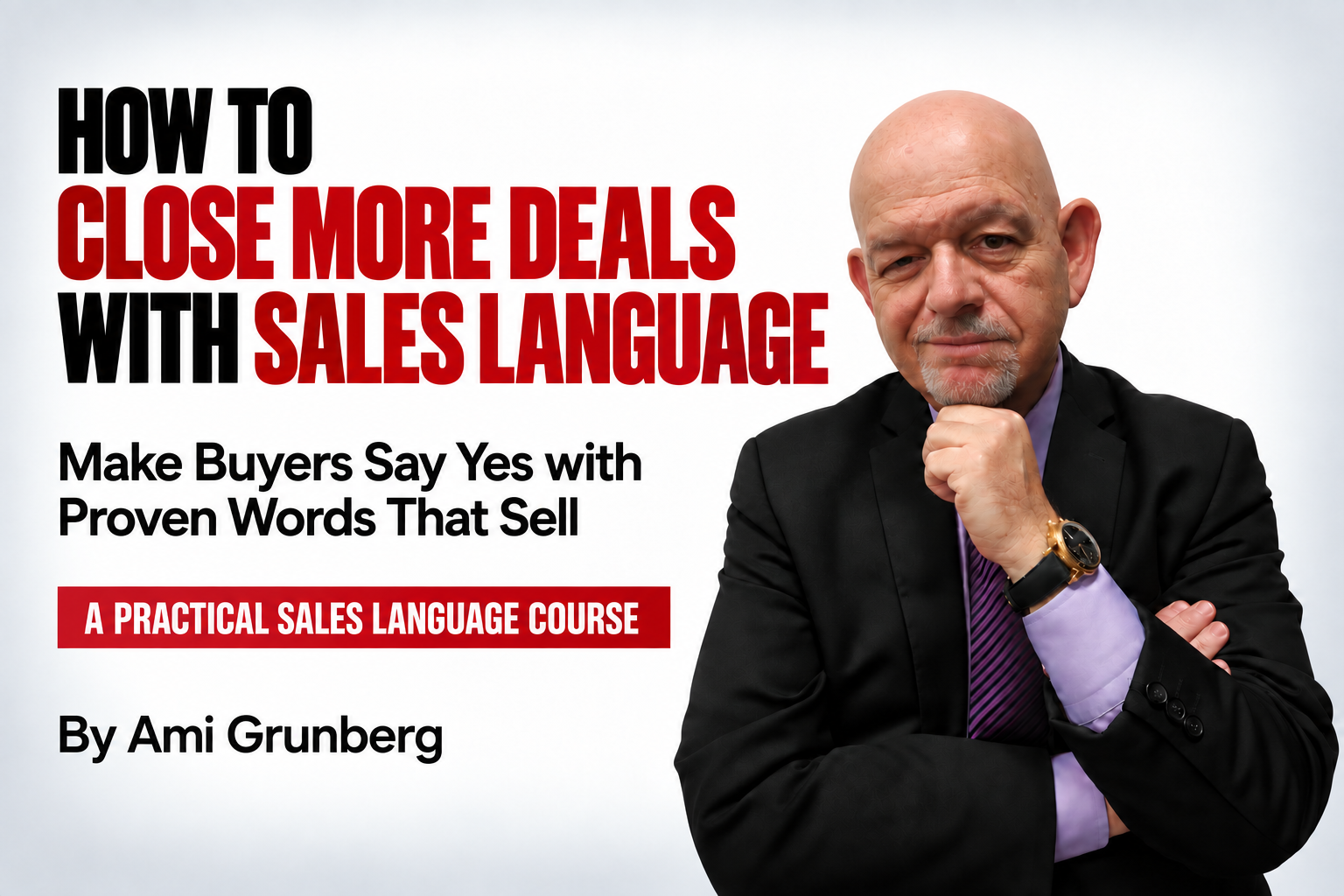
Make Buyers Say Yes with Proven Words That Sell
By Ami Grunberg
Practical language for better sales conversations
You know your product. You understand its value. You make a strong offer.
And the buyer still says:
“I need to think about it.”
Sometimes it is the way you communicate it.
The words you choose, the questions you ask, the numbers you use, your tone of voice, your body language, and even the moments when you stop talking can all influence how your message is received.
How to Close More Deals with Sales Language teaches you how to use words and communication more deliberately throughout the sales conversation.
You will discover how buyer psychology, specific words and phrases, questions, numbers, voice, body language, communication channels, and silence can influence the way buyers understand and respond to your message.
Less guessing about what to say. More deliberate communication when the sale matters.
45 Practical Lessons • Learn at Your Own Pace • Practical Sales Communication Tools
See the course before you enroll
Watch a real lesson from the course before you decide.
Practical outcomes
Choose words that strengthen your sales message
Avoid words that can create unnecessary resistance
Better understand what influences buyer decisions
Use persuasive words and phrases more effectively
Ask questions that move the conversation forward
Use numbers to make your message clearer and stronger
Create a more positive sales atmosphere
Communicate expertise without confusing the buyer
Choose the right communication channel
Strengthen your message through voice and body language
Use silence more strategically
Communicate more effectively when the buying decision matters
Course journey
Explore the meaning of sales, the new buyer, brain research related to buying behavior, and factors that can influence purchasing decisions.
Discover how specific words can influence attention, value, emotion, confidence, urgency, and action, and learn how to use them more deliberately.
Learn which words to avoid, how persuasive language patterns work, how to use target words for different purposes, ask better questions, and use numbers more effectively.
Learn how communication channels, positive language, expertise, jargon, voice, body language, and silence can strengthen or weaken your sales message.
Bring the different elements together and develop a more deliberate, professional, and effective way to communicate with buyers.
Is This Course for You?
If you sell, present, recommend, persuade, or communicate value to customers, this course was designed with you in mind.
It is especially relevant for sales professionals, business owners, entrepreneurs, consultants, freelancers, and service professionals.
You may be new to sales or you may already have years of experience. Either way, there is one tool you use in almost every sales conversation:
Your language.
Communication when the sale matters
Many sales courses focus mainly on what to do.
This course focuses on how you communicate while doing it.
The course emphasizes practical, professional communication rather than high-pressure tactics or manipulation.
The difference a conversation can make
Imagine two salespeople offering the same product at the same price to similar customers.
The difference is not always the product or the offer. Sometimes it is the conversation.
A better word can change how value is perceived. A better question can reveal what matters to the buyer. A clearer number can strengthen the message. The right tone can change how a sentence feels. A well-timed pause can give the buyer space to think.
Answers before you begin
No. The course begins with important foundations and is suitable for both newer and experienced sales professionals.
No. The course includes important concepts about sales and buyer psychology, but the emphasis is on practical sales communication you can apply in real conversations.
The course covers buyer psychology, effective sales vocabulary, words to use and avoid, persuasive language patterns, target words, questions, numbers, communication channels, positive language, expertise and jargon, voice, body language, silence, and effective sales language.
No. The approach emphasizes professional communication and influence rather than pressure or manipulation.
Yes. The course is designed for flexible online learning at your own pace.
How Many Sales Could Better Communication Change?
Think about the sales conversations you have every week. Now imagine improving the words, questions, numbers, tone, body language, and communication you bring to those conversations.
You do not need to become a different salesperson. You need to become more deliberate about the language you already use every day.Start learning today.